
Thermal Inspections in Ethanol Plants
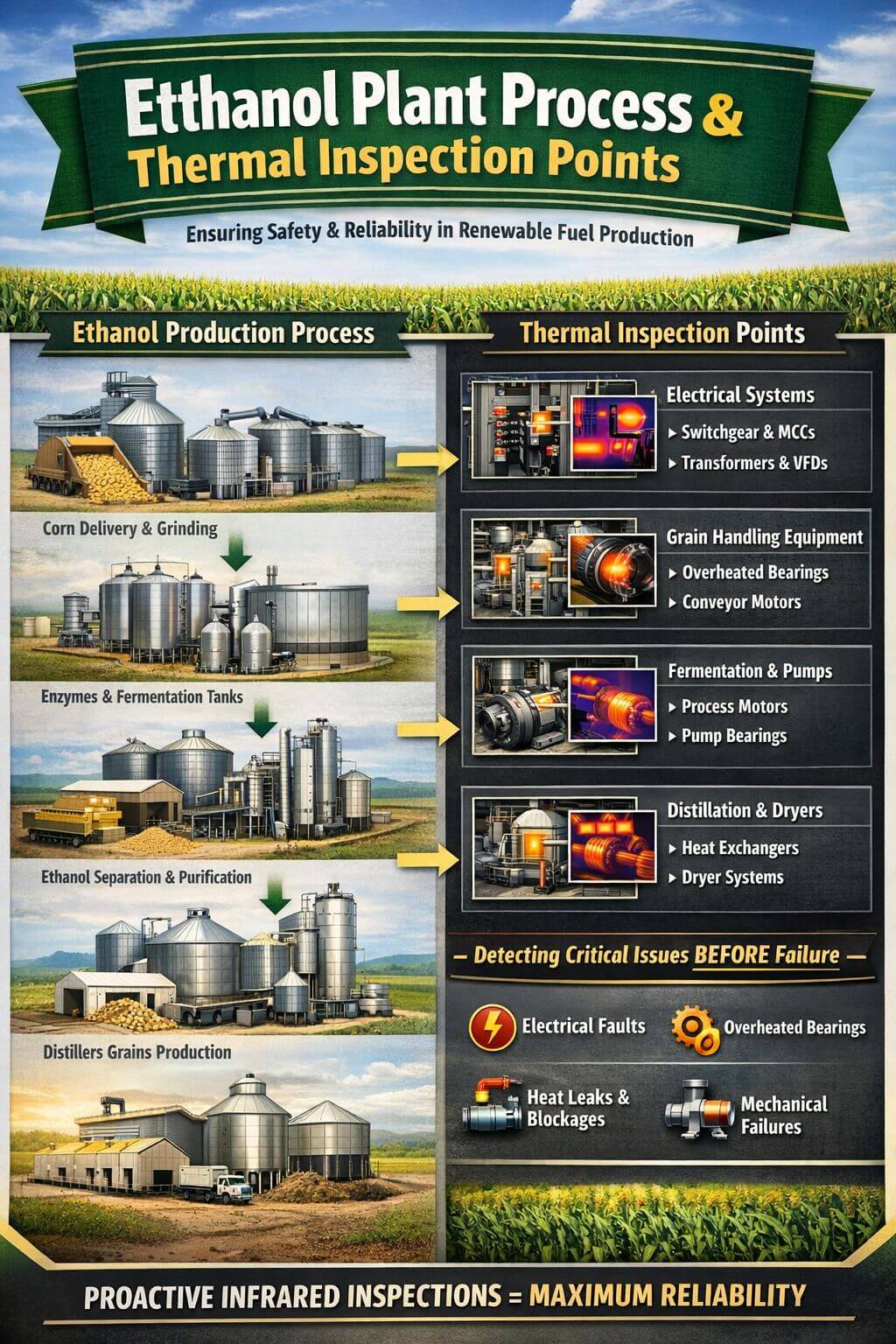
Thermal Inspections in Ethanol Plants: Protecting Production Reliability
Ethanol production has become a major pillar of the United States energy and agricultural economy. The U.S. currently produces more than 16 billion gallons of ethanol annually, making it the world’s largest producer of renewable biofuels.
While discussions surrounding energy policy can vary widely, one practical reality remains clear: ethanol production and renewable fuel blending requirements continue to increase across the United States, reinforcing the long-term importance of reliable plant infrastructure.
Federal programs such as the Renewable Fuel Standard require billions of gallons of renewable fuels to be blended into the national fuel supply each year. Expanded E15 gasoline availability and export growth have further strengthened ethanol demand.
For ethanol facilities operating in this environment, uptime and reliability are critical. Even short production interruptions can result in substantial losses.
This is where infrared thermography and thermal inspections play an important role in proactive maintenance strategies.
How Ethanol Is Manufactured
Most U.S. ethanol facilities operate using the dry-mill process, converting corn starch into ethanol fuel and valuable co-products.
The primary production stages include:
- Grain Handling & Milling
Corn is delivered to the plant, cleaned, and ground into fine meal to expose starch molecules.
- Liquefaction & Enzymatic Conversion
Enzymes convert starches into fermentable sugars.
- Fermentation
Yeast converts sugars into ethanol and carbon dioxide during fermentation cycles lasting roughly 50–60 hours.
- Distillation and Dehydration
Ethanol is separated from water and refined into fuel-grade alcohol.
- Co-Product Recovery
Residual solids are processed into distillers grains, widely used as livestock feed.
Because ethanol plants operate as continuous industrial processes, mechanical or electrical failures at any stage can quickly disrupt the entire production chain.
Where Thermal Inspections Are Most Critical
Infrared thermography allows maintenance teams to identify abnormal heat patterns that indicate electrical resistance, mechanical friction, or insulation breakdown.
In ethanol plants, thermal inspections provide significant value in several key areas.
Electrical Distribution Systems
Electrical infrastructure powers nearly every process in ethanol production.
Key inspection targets include:
- Motor Control Centers (MCCs)
- Switchgear and panelboards
- Transformers
- Variable Frequency Drives (VFDs)
- Bus duct systems
Loose connections, overloaded conductors, and deteriorating insulation create resistance and heat signatures that can be detected early through thermal inspections.
Early detection prevents:
- Unexpected electrical failures
- Arc flash hazards
- Production interruptions
Grain Handling and Milling Equipment
Corn handling equipment runs continuously and often under heavy load.
Thermal inspections can detect:
- Overheated bearings
- Conveyor misalignment
- Gearbox failures
- Motor overload conditions
Because milling systems feed the entire plant, failures here can halt production almost immediately.
Process Pumps and Fermentation Systems
Fermentation and fluid transfer rely on numerous pumps and agitators.
Infrared inspections help identify:
- Motor overheating
- Bearing degradation
- Insulation failures
- Process flow restrictions
These issues can often be detected weeks or months before catastrophic failure occurs.
Distillation and Heat Systems
Distillation is one of the most energy-intensive stages of ethanol production.
Thermal inspections help reveal:
- Heat exchanger inefficiencies
- Steam leaks
- Insulation degradation
- Process pipe blockages
Correcting these issues improves both energy efficiency and production stability.
Dryer Systems and Co-Product Processing
Distillers grain dryers operate at high temperatures and require careful monitoring.
Thermography can identify:
- Burner irregularities
- Hot spots in rotating drums
- Insulation failure
- Ductwork heat imbalance
Failures in these systems can result in production loss, fire hazards, or costly repairs.
Why Proactive Thermal Inspections Matter
Modern ethanol plants rely on complex mechanical and electrical infrastructure operating continuously.
Infrared thermography supports proactive maintenance programs by helping facilities:
- ✔ Identify developing electrical faults
- ✔ Detect mechanical overheating early
- ✔ Improve process energy efficiency
- ✔ Reduce fire and arc-flash risks
- ✔ Prevent unplanned production outages
For plants producing millions of gallons annually, predictive maintenance tools such as thermal inspections help ensure safe, efficient, and uninterrupted operations.
Supporting Reliable Renewable Fuel Infrastructure
Ethanol production remains a critical component of U.S. fuel supply and agricultural markets. With renewable fuel policies continuing to support biofuel blending and ethanol demand remaining strong, the reliability of these facilities becomes increasingly important.
Proactive inspection technologies, especially infrared thermography, play a key role in maintaining the infrastructure that supports renewable energy production.
Facilities that adopt predictive maintenance strategies are better positioned to:
- Maintain continuous production
- Protect worker safety
- Reduce operating costs
- Extend equipment life cycles