
Emissivity Explained: Why It Matters for Accurate Temperature Measurement
What Is Emissivity?
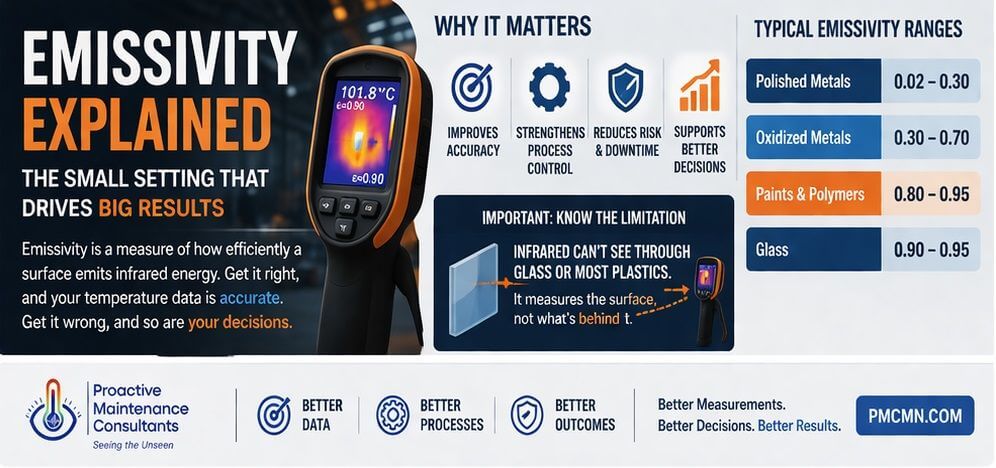
Emissivity is a measure of how efficiently a surface emits infrared energy. It is expressed as a value between 0 and 1, where 1 represents a perfect emitter (a “blackbody”), and lower values indicate more reflective materials.
In practical terms, emissivity determines how accurately infrared instruments—such as thermal cameras and infrared thermometers—can calculate temperature. These devices do not measure temperature directly; they detect emitted infrared energy and convert it using an emissivity value.
Most materials fall into general ranges:
- Low emissivity (0.02–0.30): Polished or reflective metals
- Moderate emissivity (0.30–0.70): Oxidized or rough metals
- High emissivity (0.80–0.95): Polymers, painted surfaces, and glass
Why Emissivity Matters?
Accurate temperature measurement depends on using the correct emissivity value. If the emissivity setting is incorrect, temperature readings can be significantly inaccurate.
Common impacts include:
- Measurements that are too high or too low
- Poor process control
- Reduced product quality
- Increased scrap or rework
- Potential safety or equipment risks
Even small emissivity errors can result in large temperature deviations—especially in precision applications.
Important Limitation: Infrared Does Not Measure Through Glass or Most Plastics
A common misconception is that infrared cameras can “see through” materials like glass or plastic. In reality, most standard infrared instruments cannot measure through these materials.
Instead:
- Glass and many plastics reflect and absorb infrared energy
- The instrument measures the surface temperature of the glass or plastic, not what is behind it
This has important implications:
- Measuring through a window will not give the temperature of the object inside
- Transparent materials in visible light are often opaque in the infrared spectrum
- Specialized materials (like IR-windows) are required for accurate through-window measurements
Understanding this limitation is critical to avoiding incorrect conclusions and costly errors.
What Affects Emissivity?
Emissivity is influenced by several real-world factors:
- Surface Finish: Rough or matte surfaces emit more effectively than polished ones
- Material Type: Metals behave very differently than polymers or coatings
- Oxidation & Coatings: These often increase emissivity
- Temperature: Some materials change slightly with temperature
- Environment: Dirt, moisture, or contamination can alter readings
Because of these variables, generic emissivity charts should only be used as rough references.
Typical Emissivity Values
Material | Emissivity Range | Notes |
Polished Aluminum | 0.02–0.10 | Highly reflective |
Stainless Steel (Oxidized) | 0.60–0.85 | Surface dependent |
Painted Surfaces | 0.80–0.95 | Color and coating matter |
Polymers | 0.85–0.95 | Generally consistent |
Glass | 0.90–0.95 | Measures surface, not through |
How Emissivity Is Measured
Accurate emissivity measurement requires controlled methods and proper instrumentation.
Approaches include:
- Laboratory Testing: High accuracy, controlled conditions
- Field Measurement: Real-world validation
Measurements may be:
- Directional emissivity (specific angle)
- Total emissivity (all directions)
Traceability and calibration ensure reliable, repeatable results.
Where Emissivity Matters Most
Emissivity plays a key role in industries such as:
- Plastics & Polymers: Processing and product consistency
- Aerospace & Automotive: Thermal performance validation
- Electronics & Medical Devices: Safety and reliability
- Manufacturing & QA: Process control and compliance
Any application using infrared temperature measurement depends on accurate emissivity.
The PMC Advantage
At Proactive Maintenance Consultants (PMC), we provide application-specific emissivity measurements—not assumptions.
Our services include:
- Material-specific testing based on real conditions
- Advanced, calibrated instruments
- Traceable, repeatable methods
- Clear and actionable reporting
- Support for QA, R&D, and production teams
We help ensure your temperature data is accurate—so your decisions are confident.
Common Mistakes to Avoid
- Using default emissivity settings
- Assuming infrared can measure through glass or plastic
- Ignoring changes in surface condition
- Relying solely on generic reference charts
Avoiding these pitfalls improves both accuracy and reliability.
Frequently Asked Questions (FAQs)
- Can infrared cameras see through glass or plastic?
No. Most infrared devices measure the surface temperature of these materials, not what is behind them. - Why is emissivity important?
It ensures infrared energy is correctly converted into temperature. - Does emissivity change over time?
Yes, due to oxidation, wear, and contamination. - Can I estimate emissivity?
You can, but it increases the risk of measurement error. - Are polymers easy to measure?
Generally yes, but variations still matter for precision work. - How do I ensure accurate results?
Use professional emissivity measurement with calibrated, traceable methods.
Conclusion
Emissivity is a critical factor in accurate temperature measurement—but it’s only part of the equation. Understanding material behavior, including the limitations of infrared technology, is essential.
Infrared instruments cannot measure through standard glass or most plastics. Combined with incorrect emissivity values, this misunderstanding can lead to significant errors.
With accurate emissivity data and the right measurement approach, you can improve quality, reduce risk, and make better-informed decisions.